Beyond Motivation Hacks: Why Smart Credit Card Use Can Boost Your Finances?
For decades, personal finance gurus have debated the “right” way to manage debt. Many of
the popular strategies focus on behavioral motivation, helping people
gain psychological momentum as they chip away at multiple debts. Dave Ramsey, for
instance, famously advocates paying off all credit cards and avoiding them entirely,
framing them as a source of temptation and risk.
But for those who have progressed beyond the stage of struggling with consistency,
there's a higher level of financial optimization that deserves attention. It's time to
explore how disciplined use of credit cards, combined with rational debt
management strategies, can actually advance your financial health.
The Snowball vs. Avalanche Debate
Two of the most well-known debt repayment strategies illustrate the difference between
psychological motivation and financial efficiency:
1. Debt Snowball
Pay off the smallest balances first.
- Pros: Builds momentum, gives “quick wins,” encourages consistency.
- Cons: Typically results in paying more interest
and longer payoff time.
2. Debt Avalanche
Pay off debts with the highest interest rates first, regardless of
balance size.
- Pros: Minimizes total interest paid, shortens payoff timeline,
mathematically superior.
- Cons: May feel slower if one relies on emotional rewards for
motivation.
Behavioral finance research shows that while the Snowball method can help those
struggling to stay on track, it is suboptimal financially. For
individuals capable of maintaining disciplined repayment, the Avalanche method, or even
more advanced strategies, produces objectively better outcomes. You can compare the
outcomes of the two
methods in our
debt elimination
calculator
Moving Beyond Motivation Hacks
Many people still rely on psychological tricks to make financial progress. “Seeing a zero
balance” on one account feels like a win, even if overall debt hasn't changed much. But
for disciplined financial actors, this emotional boost is no longer necessary.
Consider someone who uses multiple credit cards responsibly, paying off the
statement balance in full each month. This person is effectively debt-free,
despite never seeing a zero balance on any card due to ongoing usage. Here's why this
behavior represents optimal financial progression:
- Interest avoidance: Paying in full every month eliminates interest
charges completely.
- Credit optimization: Consistent, full payments maintain low
utilization ratios and strengthen credit scores.
- Cash flow management: Thoughtful card usage allows for convenience,
shopping protection, rewards, and tracking spending without
incurring debt.
- Rational mindset: Focus is placed on total financial efficiency
rather than emotional reinforcement.
Counterpoint to a finance guru
Dave Ramsey's advice to avoid credit cards entirely stems from a practical concern: many
people misuse them and incur high interest, ultimately falling into a debt trap. For
beginners or inconsistent spenders, his caution is valid.
However, for disciplined users, strict avoidance is not only unnecessary but also
potentially suboptimal, considering the following factors:
- Opportunity cost: Using credit cards responsibly can generate
rewards (cashback, points, or travel benefits) that paying entirely in cash cannot
replicate.
- Credit history: Active, well-managed credit contributes positively
to your credit score, affecting mortgage rates, loan approvals, and financial
flexibility.
- Financial efficiency: Full monthly payments ensure no interest
accrues, making credit cards a neutral or even beneficial financial tool rather than
a liability.
In other words, a finance guru's one-size-fits-all approach may not account for those
who have mastered self-discipline and
rational financial planning. At higher
levels of financial literacy, credit cards are tools, not traps, and can enhance
long-term financial outcomes.
The Path Forward
Financial growth is a journey. Beginners often need strategies like the Snowball method
to stay on track. But those willing to measure, calculate, and optimize
should strive for higher-level financial behavior:
- Use interest rate-focused repayment strategies for any actual debt.
- Treat credit cards as cash flow management and rewards tools,
paying balances in full.
- Focus on total financial efficiency rather than per-account “wins.”
- Avoid unnecessary psychological shortcuts once consistent behavior is established.
By moving beyond motivation-based hacks, individuals can achieve both
financial freedom and optimization, turning tools like credit cards
into allies
rather than liabilities.
Conclusion
Debt management is often framed as a battle of motivation versus logic. Beginners may
need psychological reinforcement, but advanced financial actors understand that
mathematics and discipline outperform motivation hacks. Paying off debt
efficiently, using credit responsibly, and viewing finances holistically represents the
next stage in financial evolution, a stage where strict avoidance of
credit cards is unnecessary, and rational behavior becomes the true driver of financial
success.
Why Choosing Credit Over Cash Can Signal Financial Savvy, and Not Just Income
According to the Federal Reserve's 2023 survey Diary of Consumer Payment Choice,
there is a pronounced link between household income and payment method: households
earning less than $25,000 per year used cash for a much larger share of their
transactions than households earning more than $150,000. As showed in the following
figure, in that lowest-income group, roughly 36% of payments were made in cash
, more than three times the cash share of the highest-income households (10%). On the
flip side, credit card use rises sharply with income: among the highest-earning
households, around 50% of payments were via credit card, about four times the
credit card usage of the lowest-income group.
Shares of credit card use by household income (Source: FRB
Services)
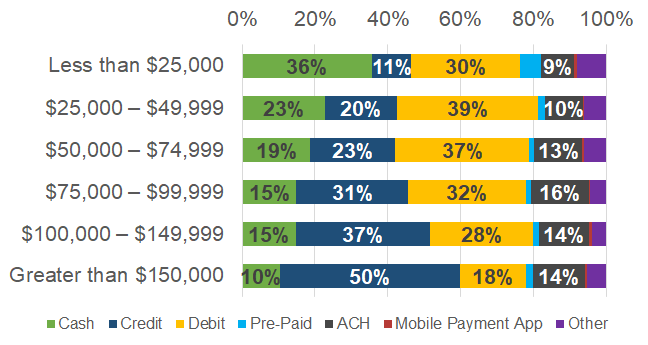
Put simply: cash use remains disproportionately common among the lowest-income
households, while credit card use is significantly overrepresented among higher-income
ones.
Beyond Perception: Why Credit-Card Use Can Signal Financial Savviness
If you want to position yourself (or have others perceive you) as financially secure and
savvy, not just “not poor” but “smart with money”, using credit cards can carry
advantages beyond optics.
- Convenience and record keeping: Cards are widely accepted and
provide a built-in transaction history, whereas cash often lacks a clear record.
- Access to perks and financial flexibility: Many credit cards offer
rewards (cash back, points, travel benefits), effectively reducing your cost of
living when used wisely.
- Signal of access to banking and credit infrastructure: Using a
credit card assumes you have and responsibly manage access to banking and a credit
line, implying financial stability.
- A modern, minimalist status signal: Paying with credit instead of
cash can feel more “normalized” in professional or social settings.
In other words, using credit cards (when financially responsible) doesn't just keep up
appearances. It can reflect actual financial competence and even provide tangible
benefits like rewards and record-keeping advantages compared to sticking with cash or
debit.
Considerations & Why It's Not Just About Showing Off
That said, this argument doesn't mean cash or debit is “bad,” or that people who use cash
are necessarily poor or irresponsible. There are valid reasons to rely on cash or debit:
budgeting, privacy, avoiding debt, or lack of access to a credit account. Indeed, the
report notes that many people still use cash, and that cash remains a “fallback” payment
method when necessary.
But if you do have access to credit, and you manage it well (e.g., pay
on time, avoid carrying balances, stay within means), then credit card use can function
as a subtle signal: that you are financially stable, comfortable, and savvy.
If You Care About How Others Perceive You, Using Credit Makes Sense
Social perceptions around money shape how people treat you: in professional settings,
social outings, or everyday interactions. If you want to avoid triggering assumptions
that you're in a low-income bracket, consistently using your credit card can silently
communicate that you have not only the means, but also the discipline.
Moreover, from a smart money standpoint, credit card use offers practical upside:
convenience, visibility, record-keeping, and rewards. So long as you treat it as a tool,
not as “easy debt”, using a credit card strategically can be both a financial
advantage and a social signal.
Conclusion
In today's payment landscape, where plastic (cards) increasingly dominates, your choice
of payment says more than you might think. According to the data from the Diary of
Consumer Payment Choice, using cash or debit tends to be strongly correlated
with lower household income, while credit card use is heavily skewed toward
higher-income groups.
If you care about how others might perceive your financial status, and if you have
access to credit and the discipline to pay it off, thoughtful credit card use isn't
about pretension; it can reflect real financial competence. In that sense, using credit
cards strategically can be both smart and socially advantageous.